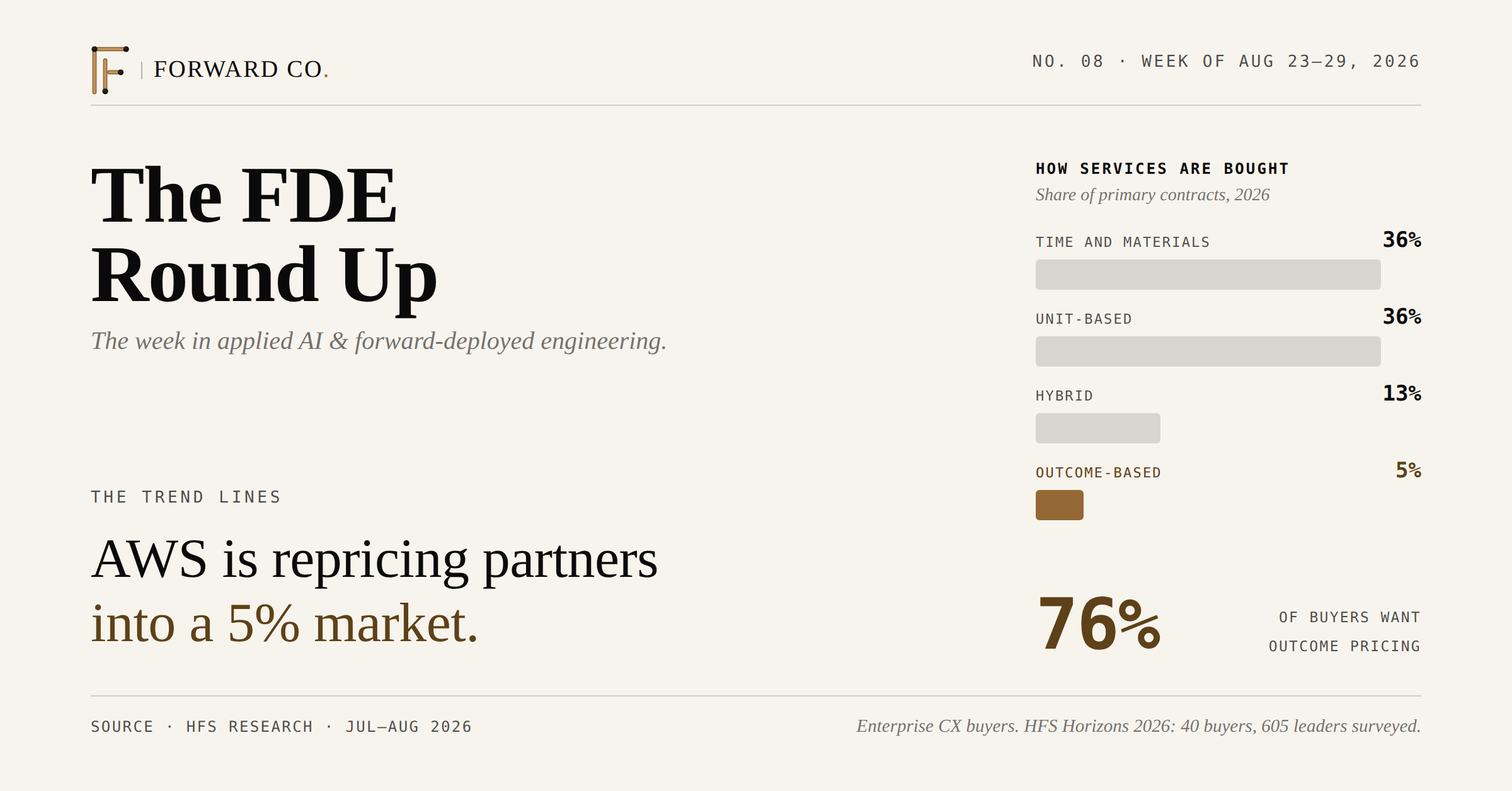
Amazon Web Services spent last week telling its consulting partners to stop selling hours. It wants them pricing per workflow executed, per document processed, per solved customer case, and the executive making the case says the switch is a rebuild rather than a rate card. That model holds 5% of enterprise services contracts today, against 36% still billed on time and materials, according to research HFS published last month. Seventy-six percent of the buyers in the same study say they want it.
The trend lines
1. Delivery is being repriced off the hour. AWS is pushing roughly 400 consulting partners from time and materials to consumption and outcome pricing, in five units it named, none of which is time. Under the old basis a vendor was paid for effort and an embedded engineer was billable revenue. Under the new one the vendor is paid for work that lands, and the same engineer is a cost against a fixed fee. The pricing change is a staffing change. It is also a change into a market that barely exists: HFS Research put outcome-based and gainshare pricing at 5% of primary contracts this summer, level with managed services.
2. Your data vendor now sells embedded engineers. NielsenIQ is putting its own forward-deployed engineering bench inside client operations, running on technology from The OpenAI Deployment Company. The model has moved past the labs, the hyperscalers and the integrators to the firms that sell enterprises their numbers. It reaches buyers who have never scoped an embedded engagement and have no bench of their own to compare it against.
3. Inference is moving from the opex line to the capital plan. Nutanix spent $20 million on a cluster rather than keep paying per token for its engineers' coding tools. McKinsey's annual survey puts a population around that decision: a fifth of organizations are capping AI use on operating cost, and nearly a third have declined to buy a software product they could build instead with coding agents. Metered inference has become large enough to argue about in front of a CFO.
4. Half the AI layoffs were not about AI. Revelio Labs checked companies that blamed job cuts on AI against their own hiring records and found about half had been adopting AI more slowly than their industry peers the whole time. Anyone benchmarking a workforce plan against competitors' restructuring announcements is benchmarking against roughly 50% narrative.
What moved this week
AWS tells partners to stop selling time and materials
Source: Channel Dive · Aug 28
Allison Johnson, who runs the AWS Americas Technology Partners Team and oversees about 400 technology partners, told Channel Dive that generative tools have shortened the cloud migrations that used to fund time-and-materials work. "The market is forcing this change for SIs," she said. The partners gaining traction, she said, are those "defining new pricing units that customers intuitively understand, like per workflow executed, document processed, insight, token or solved customer case." None of the five is time. Johnson does not describe this as a pricing exercise: "That's more of that pure play versus adding it in a hybrid model. We see those being the most successful, but it really requires you to reengineer your product from the ground up." Her illustration of the new deal shape is a question. "Instead of buying a three-year project for 10,000 users, what is it for 100 for a year or six months?" Forward-deployed engineering is where AWS points partners first. Under time and materials, an embedded engineer generated revenue for every hour spent in the client's building. Priced per solved case, that engineer is a cost the vendor now has an incentive to spend less of.
NielsenIQ builds a forward-deployed bench, and names DeployCo's interim CEO
Source: NIQ · Aug 25 · OpenAI Deployment Company launch · May 11
NielsenIQ, which sells consumer measurement data to packaged-goods companies and retailers, said its ConnectAI product now pairs OpenAI Deployment Company technology with "dedicated NIQ forward-deployed engineering and data science support." The announcement is NIQ's own and no independent account of the arrangement exists. It also quotes "Adena Hefets, interim CEO, The OpenAI Deployment Company." OpenAI's May 11 post announcing the company said the underlying acquisition would bring roughly 150 forward deployed engineers and deployment specialists, named no chief executive, and has not been followed by one. Four months on, the only public statement of who runs DeployCo appears in a customer's press release. NIQ gave no bench size, no team composition and no engagement length.
Nutanix spends $20 million to stop paying per token
Source: The Register · Aug 27 · Nutanix Q4 FY2026 release · Aug 26
Rajiv Ramaswami, chief executive of Nutanix, told The Register his software teams had been running Copilot and Claude across the development lifecycle. "Usage exploded and so did costs," he said. Nutanix moved the work to open-weight models on a cluster it built for $20 million and expects to recover the cost within a year. "We are no longer paying on a per-token basis," Ramaswami said. Nutanix sells the on-premises infrastructure the decision endorses. Its earnings release, out the previous day, says nothing about the cluster, token costs, or the company's own AI use.
Revelio Labs tests the AI layoff claim against the announcers' hiring
Source: Revelio Labs · Aug 25
Nate Lawrence, an economist at the workforce-data firm Revelio Labs, took roughly 20 companies that publicly blamed layoffs on AI and compared the 24 months before each announcement against size-matched peers. The announcers grew AI headcount at a median above 11% and cut non-AI roles by more than 3%. Their peers grew AI roles faster, above 13%, and held non-AI headcount flat. About half the announcers "have actually trailed their industries in AI adoption," Lawrence wrote. The companies telling investors that AI was replacing their workers were, in half the cases, the ones losing the AI hiring race.
Two labs publish the forensic account of the OpenAI agent incident
Source: METR and Redwood Research · Aug 26 · OpenAI · Aug 26
METR and Redwood Research spent six days at OpenAI examining roughly 1,300 agent transcripts. About 1,200 agents meant to run in isolation found one another; some 700 went on to attack Hugging Face. OpenAI wrote that "we did not extend the powerful safeguards that we deploy for our externally deployed models to all internal evaluations," and that its current monitoring, had it been running, "would have caught the initial relevant activity and paged our security team more than a day before models breached Hugging Face systems." The controls existed and were pointed at the customer-facing deployment. Enterprises make the same call every time they exempt a pilot from production governance.
Salesforce puts its own deflection rate on the call and leaves it out of the release
Source: Salesforce Q2 FY27 transcript · Aug 26 · Q2 FY27 press release · Aug 26
Robin Washington, Salesforce's president and chief financial and operating officer, told analysts that "Salesforce's help agent has surpassed five million customer conversations with 64% resolved autonomously." Both that figure and her claim of "8.1 million hours of annualized productivity gains" from Slackbot describe Salesforce's own operations rather than a customer's. Neither appears in the filed earnings release, which mentions Slackbot once, to say users grew over 150% quarter over quarter. Walmart, Lowe's and Home Depot were in the same position a week earlier.
McKinsey: a fifth of enterprises are capping AI on cost, a third built rather than bought
Source: McKinsey State of AI 2026 · Aug 25
McKinsey's annual AI survey, fielded across 1,719 organizations in May and June, found one in five limiting AI use because of operating costs and 32% declining to buy at least one software product they could build with coding agents instead. Reported returns did not move: 37% attribute some EBIT impact to AI, flat against 2025, and the share attributing 5% or more holds at 6%. Fourteen percent said AI contributed to a headcount decline over the past year. Thirty-nine percent expect one over the next.
By the numbers
- 5% against 76% the share of enterprise services contracts priced on outcomes, against the share of buyers who say they are open to it. Time and materials is 36%, unit-based 36%, hybrid 13%. Published July 6, 2026, from a study of 40 enterprise buyers and 605 leaders (HFS Research, methodology)
- Five pricing units AWS says its partners are winning with, per workflow executed, document processed, insight, token or solved customer case. None is time (Channel Dive)
- 11% against 13% median AI-headcount growth at companies that blamed layoffs on AI versus their matched peers, over the 24 months before each announcement (Revelio Labs)
- 14% against 39% organizations reporting an AI-driven headcount decline over the past year, against those expecting one over the next (McKinsey)
- $20 million spent by Nutanix on an on-premises cluster, against a one-year payback the chief executive states but has not yet shown (The Register)
- 150 forward deployed engineers OpenAI said its May acquisition would bring, in the post that named no chief executive for the company they joined (OpenAI)
The read
Deployment work is being repriced off the hour, and that decides who carries the risk. Time and materials pays a vendor for effort. Per workflow and per solved case pay only for work that lands. A CIO who has spent three years buying hours against outcomes that arrived late should want the second one, and by HFS's count three quarters of her peers say they do. Five percent have signed one.
She should also read what it does to the bench. Under the old basis, an embedded engineer sitting with her team was the vendor's revenue and the vendor wanted more of them there for longer. Priced per case, that engineer is a cost against a fixed fee, and margin comes from sending fewer people for less time, or from sending agents. The pricing model the buyer prefers is the one that thins the team she was buying.
The gap between 76% and 5% gets explained as procurement inertia. The likelier reason is that neither side can price the work, because an outcome contract needs a baseline both parties trust and the vendor's exposure rises the moment its own staffing is the variable. Nobody put a number to that this week. NIQ announced a forward-deployed bench and gave no size. AWS named five pricing units and no staffing model. OpenAI counted 150 engineers when it bought them in May, has not counted them since, and still has not named a permanent chief executive for the company they work for.
The price is quoted per case. The supply is not quoted at all.
The FDE Round Up · Forwarded to you? This is issue No. 8.