Anthropic's services venture bought its second implementation firm since May, the month OpenAI stood up a deployment company of its own. The compensation data that landed this week says the same thing from the other side: the people who do the deploying are the ones being repriced.
Four trends ran through the week.
The trend lines
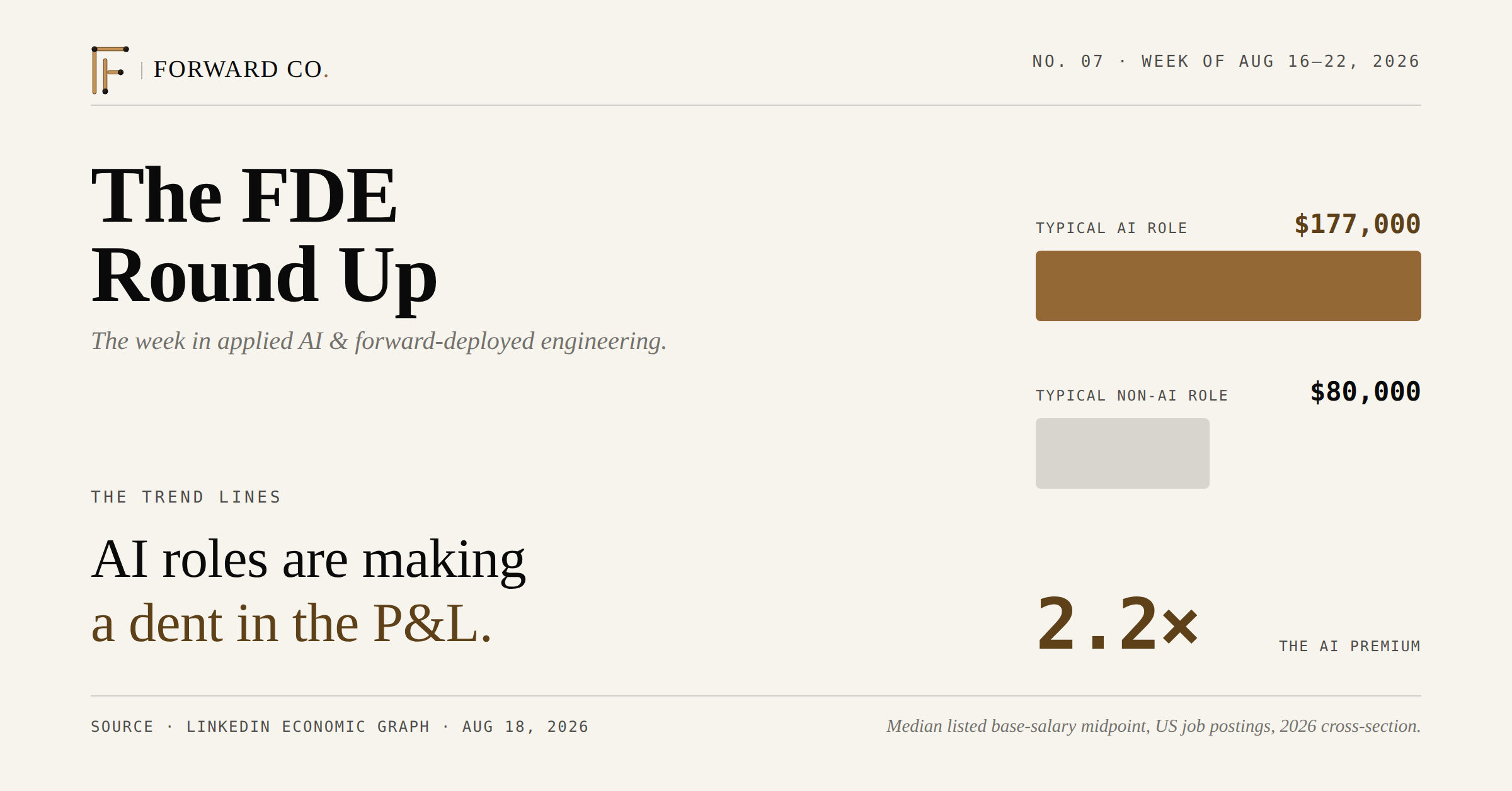
1. The pay premium left the org chart and went to the field. LinkedIn's Economic Graph team published the first first-party dataset that treats forward deployed engineer as a named occupation with its own pay curve. The finding worth your attention is not that AI roles pay more. It is the direction of travel inside them: Member of Technical Staff and Forward Deployed Engineer saw the fastest increases in listed compensation, while Head of AI and AI Engineer have been flat since 2024 and VP of AI has declined from highs above $300K. The market is repricing the people who deploy, not the people who preside. If you are budgeting an applied AI function, the escalator is under your engineers.
2. The model vendors are buying the firms that install their models. Ode with Anthropic acquired Casper Studios on Thursday, its second acquisition since May, and it is backed by Anthropic itself alongside Blackstone, Hellman & Friedman and Goldman Sachs. OpenAI ran the same play in May, an acquisition it said would bring roughly 150 forward deployed engineers and deployment specialists. Implementation is being treated as the scarce asset, and it is being bought rather than partnered with. For a buyer that turns a diligence question into a structural one: when the firm embedding engineers in your operation is a subsidiary of the vendor whose model they install, technology-agnostic is a promise rather than an arrangement.
3. Enterprises will say their AI numbers out loud and leave them out of the filing. Walmart and Lowe's both put concrete, revenue-side AI results on their earnings calls in the same week. Neither figure appears in the filed 8-K or the press release. That is a disclosure choice, not an oversight: quantified AI claims are being made in the venue that carries no filing liability. Read every AI number you are shown from a peer with that in mind, and notice which of your own you would be willing to file.
4. The cost control point moved from the model contract to the router. Stripe agreed to buy OpenRouter, Ramp shipped a competing router four days later, and Snowflake put automatic cost-based routing inside the warehouse, all inside one week. All three are betting that the leverage in enterprise AI spend is no longer which model you sign but which model each individual request reaches. Gartner published the reason the same week: per-token prices keep falling while per-task token consumption rises faster.
What moved this week
LinkedIn puts a pay curve on the forward deployed engineer for the first time
Source: The AI Talent Divide, LinkedIn Economic Graph Research Institute · Aug 18 · newsroom release · report index
The AI Talent Divide reports US postings from 2023 to 2026 with disclosed compensation, excludes any occupation-year with fewer than 30 qualifying postings, and states its own limits plainly. The typical AI job posting lists a base-salary midpoint of $177,000, against $80,000 for the typical non-AI role. Inside the AI set, deployment-facing individual contributor roles are where listed pay is still climbing while the leadership titles have gone flat or down. One more number belongs in your staffing plan: more than two thirds of both AI Engineer and Forward Deployed Engineer hires in 2025 were Gen Z, which sits awkwardly against a CNBC and SurveyMonkey finding the next day that 35% of workers would bar junior employees from using AI at all.
Walmart and Lowe's quantify AI on the call and omit it from the filing
Source: Walmart Q2 FY27 transcript · Aug 20 · Lowe's Q2 transcript · Aug 19
Walmart CEO John Furner told analysts that customers using the Sparky assistant spend 40% more per order and that the user base grew 70% year over year. A day earlier, Lowe's CEO Marvin Ellison said online customers who use MyLow convert at three times the rate of those who do not, on more than 25 million questions handled since launch. Both are unusually specific, revenue-side rather than cost-side, and attributable to a named chief executive. Neither appears in the 8-K earnings release or the press release. For contrast, Home Depot's Jordan Broggi, EVP for customer experience, told the same week's call that the Magic Apron assistant is fielding "millions of questions per month", and attached no outcome to it at all.
Stripe agrees to buy OpenRouter, and the routing layer stops being neutral
Source: Stripe newsroom · Aug 19 · first reported by Bloomberg · Aug 16
OpenRouter is the gateway a large share of enterprises use to arbitrage between closed and open-weight models, and it carries more than 10 trillion tokens a day across 400 models. Patrick Collison framed the logic directly: "Tokens are the central currency for companies building with AI." Stripe disclosed no terms, and the $8 billion figure in circulation traces to the Financial Times rather than either company, so treat it as reported, not confirmed. The buyer's question is narrower than the headline: the layer choosing your model on every request is now owned by a company that monetizes metering, which makes data retention and pricing commitments worth a contract read.
An Anthropic-backed firm buys the shop that installs Anthropic
Source: Ode with Anthropic · Aug 20 · first reported by The Information · Aug 20
Ode with Anthropic acquired Casper Studios, an AI services firm that implements Claude inside companies' existing systems and is an Anthropic Select Services Partner. Terms were not disclosed and no price has surfaced from either company. It is the venture's second acquisition in four months: it was announced in May by Anthropic, Blackstone, Hellman & Friedman and Goldman Sachs, bought Fractional AI weeks later, and relaunched under the Ode name in July. Board member Rodney Zemmel, who runs Blackstone's operating team, framed the logic: "Very few firms can take a company from one hard custom build to AI running throughout the business, and that is exactly what this combination does." The number worth holding is not the price, which nobody has published. It is that OpenAI ran the same play in May, announcing a Tomoro acquisition it said would bring roughly 150 forward deployed engineers and deployment specialists. Two model vendors are now buying the firms that embed engineers in your operation.
Forrester scores implementation and transformation services as among the most AI-disrupted markets
Source: Forrester · Aug 19
The new AI Disruption Model scores 17 technology and service categories across more than 200 markets on substitutability, labor intensity, agentic workload support, switching costs and six other axes. Transformation services, technology implementation and software development land among the most exposed, on the reasoning that AI substitutes most directly for people-delivered activity. VP and principal analyst Craig Le Clair: "AI's benefits will not be distributed evenly across technology markets." This is the durable-moat critique of forward deployed engineering arriving in analyst form, and it lands in the same week the pay data says deployment labor is getting more expensive. Both can be true, and together they describe a margin squeeze on anyone selling the model as a service.
Gartner names the inference paradox: cheaper tokens, costlier tasks
Source: Gartner · Aug 17
Gartner projects inference cost per agentic workflow to rise more than fivefold through 2028, with a single agentic reasoning call costing at least five times a basic chatbot interaction. Senior director analyst Will Sommer: "Product leaders cannot rely on more efficient token economics to rationalize AI costs." Worth stating plainly, since the number will be quoted at you all quarter: Gartner published no methodology, sample or fieldwork period with this forecast, and a forecast is not a measurement. Use it as vocabulary for the budget conversation, not as evidence.
Most enterprises can see an agent going wrong and cannot stop it
Source: HFS Research, in partnership with TCS · Aug 17
Across 101 C-suite and technology leaders in the US and Canada, 59% say they can quickly detect when an AI system is misbehaving and only 23% say they can routinely stop it before it acts. Fifty-six percent had to intervene to correct or halt an AI outcome in the past twelve months. The report is by HFS executive research leader Dana Daher and associate practice leader Hridika Biswas, and its title is the question: "Is your AI reliable enough to be trusted?" Two caveats you should carry with the number: the sample is small enough to be directional rather than a market estimate, and the research partner, TCS, sells the governance services the finding implies you need.
By the numbers
- $177,000 vs $80,000 median listed base-salary midpoint for AI versus non-AI US job postings, 2026 cross-section (LinkedIn Economic Graph)
- 40% more spent per order by Walmart customers using Sparky, quarter ended July 31 (Walmart Q2 FY27 call)
- 3x the online conversion rate for Lowe's customers who use MyLow, quarter ended July 31 (Lowe's Q2 call)
- 23% of executives can routinely stop a misbehaving AI, against 59% who can detect one, n=101 (HFS Research with TCS)
- 10 trillion tokens a day routed through OpenRouter as of the acquisition announcement (OpenRouter)
The read
Four instruments, four different methodologies, one direction. Compensation data says the premium is moving to the engineers who deploy. Two retail CEOs put real numbers on deployed AI and kept them out of the filing. Three companies moved in one week to own the layer that routes each request. An analyst house scored the implementation business as among the most exposed to the thing it implements, in the same week a model vendor's own services arm bought another firm that implements it.
The common thread is that enterprise AI value is being located, priced, and fought over at the point of deployment rather than the point of purchase. That is good news for anyone who can actually field the capability and a problem for anyone selling it as a headcount. The question to carry into your next vendor conversation is not what the model can do. It is what happens to the arrangement when the engineers who built it leave, and whether you could put the results in a filing.
The FDE Round Up · Forwarded to you? This is issue No. 7.